
For many students, dictation exercises represent some of the most anxiety-inducing moments of their school years. Certain words simply refuse to stick in memory no matter how many times they are studied, and one bad mark follows another in a cycle that can make writing feel less like a skill and more like a punishment. That early struggle with spelling and grammar is a surprisingly relatable starting point for a game like Epistory Typing Chronicles, a title that takes the act of typing and transforms it into the central mechanic of an entire adventure. In a pleasingly circular twist of fate, the very thing that once caused frustration in the classroom becomes the foundation of something genuinely joyful here.
What Kind of Game Is Epistory Typing Chronicles?
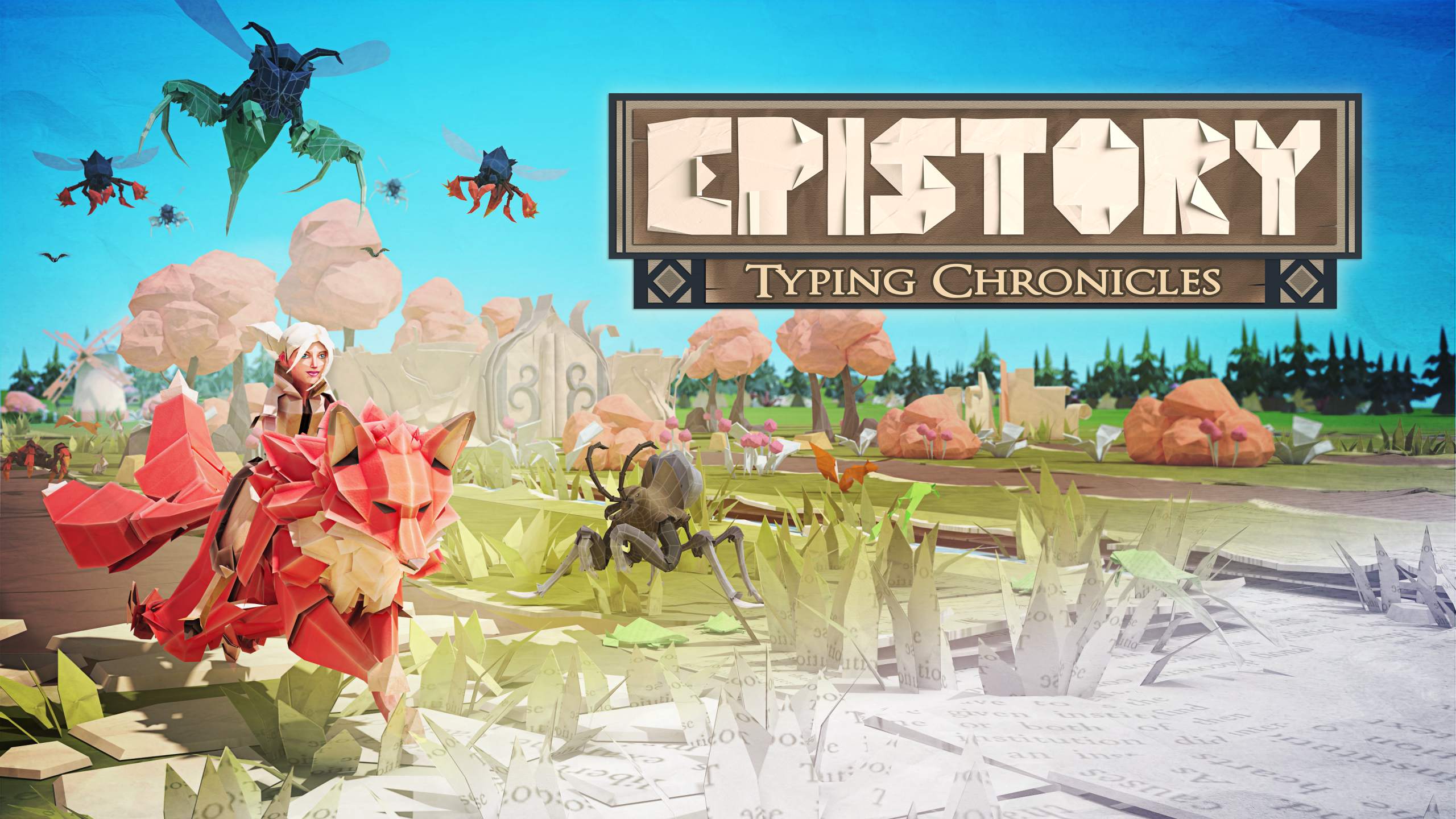
Epistory places the player in the role of a young girl who travels through a breathtaking origami world atop a fox companion. A female narrator weaves a story around the journey, describing how this paper-folded landscape has changed, how shadows have crept into every corner, and how the once peaceful world has lost its ability to protect itself. The player arrives as both a traveller and a defender, and the method of interacting with this world is entirely through typing.
In practice, this means that obstacles blocking the path, such as fallen tree trunks or tangled thickets, are cleared by typing the word that appears above them when the player enters typing mode. Beds of flowers are coaxed back to life by spelling out their names. The further the journey takes the player into the game world, the wider the range of effects that written words can produce, and the more profoundly the act of typing reshapes the environment around the fox and her rider.
Combat Through the Written Word
Not every interaction in Epistory is peaceful. The game’s insectoid enemies are defeated entirely through typing, and while early encounters are manageable, the challenge escalates steadily as the adventure progresses. There is an observable logic to the enemy design: larger insects carry slower but more complex words above their heads, meaning the player must correctly type lengthy constructions such as “unconstitutionality” under pressure and in increasingly crowded combat situations. For players who are not native English speakers, these moments introduce a particular kind of tension that mixes genuine learning with genuine panic.
Surprisingly, the most challenging enemies turn out not to be the ones with the longest words. The fastest enemies carry only a single letter, but they swarm in large numbers and move with relentless speed. Against a cloud of these rapid, one-letter threats, the act of typing becomes something close to controlled chaos, and those encounters push the player’s reaction time to its limit in ways that sprawling vocabulary words simply do not.
Elemental Spells and Strategic Depth
Beyond simple typed combat, Epistory introduces an elemental spell system that adds a layer of strategic thinking to battles. When the word above an enemy is displayed in orange, it signals that a fire element must be applied to the attack. Successfully completing that word with the correct elemental charge causes the next word in the enemy’s health sequence to ignite, providing extra time before the creature reaches the player. Similar mechanics apply to other elements, and learning to manage these layers while also keeping up with the typing itself creates a satisfying rhythm of planning and execution that gives the combat genuine depth.
Unlocking the World and Earning Upgrades
Progress through Epistory is tied directly to performance. Typing words in rapid succession earns points, and accumulating enough of them unlocks new regions of the game world, which fold themselves into existence in real time from flat sheets of paper. Watching a new landscape assemble itself out of nothing through origami animation is consistently delightful, and it reinforces the game’s central visual identity in a way that never grows old.
Paper scraps collected from defeated enemies and discovered treasure chests convert into upgrade points, which can be spent on improving spells and abilities. Among the upgrades available, two stand out as particularly transformative: a knockback ability that pushes enemies away during combat, providing breathing room in tight situations, and an increase to the fox’s walking speed. Given how much ground the game asks the player to cover on foot, the latter upgrade rapidly moves from convenient to essential.
Language Options and Accessibility
One of Epistory’s more quietly impressive features is its language support. The game includes no fewer than 11 language options, meaning players can choose to type in their native tongue or use the game as an opportunity to practice a different language entirely. For those who want to sharpen skills in a second or third language, the mechanic provides a surprisingly effective low-stakes environment for doing exactly that. For everyone else, the breadth of language choices ensures that almost no player is left out.
Whatever language is selected, the effect of extended play is the same: typing speed and accuracy improve simply through repetition and necessity. The game applies its own kind of pressure that no classroom drill quite replicates, because the consequences of slow or inaccurate typing are immediate and visible in the form of insects closing in from every direction.
World Design, Atmosphere, and Soundtrack
The origami aesthetic that defines Epistory’s visual world is not merely decorative. It serves a practical purpose as well. The game world is intentionally flat, which ensures that enemies approaching from any direction remain clearly visible and manageable to track. Hills and mountains, while visually appealing in other contexts, would obscure the movement of enemies in ways that would make combat unfair rather than challenging. The flat paper landscape is therefore both a beautiful artistic choice and a thoughtful design decision.
The soundtrack complements the visual world effectively. Certain melodies are genuinely memorable without becoming intrusive, and the music supports the contemplative atmosphere of exploration as much as it underscores the urgency of combat. There are moments in the game where the pace slows enough to simply move through the world and absorb the combination of soft music, rustling paper textures, and the narrator’s storytelling without any combat pressure, and those moments are among the most enjoyable the game offers.
Final Thoughts
Epistory Typing Chronicles is a game that should not work as well as it does. The concept of typing words to interact with a game world sounds like an educational exercise dressed up in minimal production values, the kind of thing assigned in a computer class rather than played by choice. The reality is the opposite. The game is genuinely beautiful, inventive in its mechanics, satisfying in its progression, and quietly clever in the way it challenges and rewards the player simultaneously.
It earns its place as a recommendation for anyone who enjoys games that offer something genuinely different from the mainstream, particularly those who want an experience that rewards attention and skill without demanding reflexes borrowed from dedicated action games. Once the first few hours pass and the full scope of the typing system opens up, it becomes clear that Epistory is not a typing tutor pretending to be a game. It is simply a very good game that happens to be played entirely through words.