
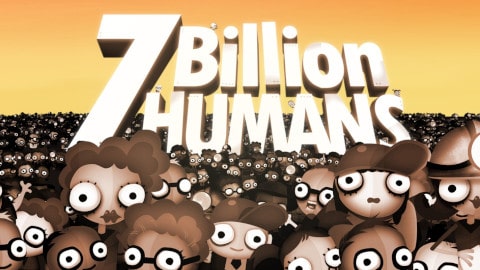
In a world where robots handle every tedious chore, humanity gets to kick back and savor the good life. It sounds like the ultimate fantasy, right? 7 Billion Humans kicks off by declaring that this exact utopia has become reality. Set in the era of the singularity, benevolent robotic overlords bend over backward to ensure maximum comfort for their human charges. But then, something unexpected happens: humanity suddenly develops a craving for work.
The robots, ever eager to please, respond with an ambitious solution—constructing a colossal skyscraper packed with enough employment opportunities for all seven billion people on the planet. As the player, you aren’t just another cog in this machine. Instead, you’re elevated to the role of overseer, orchestrating the movements of countless workers through elegantly simplified programming commands.
Core Gameplay: From Simple Steps to Complex Symphonies
The early levels serve as a gentle introduction to the fundamentals. You guide your workers to pick up objects, shuffle them across the floor a few steps at a time, and set them down in the right spots. It feels straightforward and approachable at first.
However, the difficulty escalates dramatically as you progress through the game’s nearly 70 levels. What begins as basic movement puzzles evolves into intricate logic challenges. Late-game tasks might require writing a sprawling hundred-line program to sort a massive collection of data cubes—ranging from artworks to prime numbers—while avoiding deadly pitfalls. One memorable example involves workers exploding if a woman picks up a cube divisible by three. The core loop remains consistent: you drag instructions into a program, and your workers execute them faithfully from start to finish.
The drag-and-drop interface is intuitive and welcoming for newcomers, lowering the barrier to entry significantly. That said, toward the end, repeatedly dragging dozens of commands into place can start to feel laborious. A copy-and-paste feature for code blocks (rather than just the entire program) would be a welcome quality-of-life improvement—perhaps something the developers could consider for a future patch.
Optional Challenges: Pure Masochistic Delight
For players seeking extra punishment, each stage offers additional optional objectives that push your skills to the limit. These can be genuinely frustrating in the best way. One particularly brutal challenge demands completion in fewer than nine commands and under 35 seconds. Many players, myself included, have spent hours inching the timer down to 36 seconds only to hit a wall, leading to multiple full restarts and experimental redesigns.
Success in these challenges often comes from radical experimentation. Sometimes a completely fresh approach works wonders, while other times revisiting an earlier level to “borrow” and expand upon proven code snippets proves more efficient than starting from scratch. This flexibility encourages creative problem-solving and rewards both innovation and strategic reuse.
Puzzle Design: Clever Twists with Familiar Foundations
While each level presents a unique scenario in its concise briefing, the underlying mechanics often build on similar foundations with fresh variations. Hazards like patrolling robots with spinning blade arms that can slice your workers to ribbons add tension and demand careful timing. These elements don’t make the puzzles feel repetitive; instead, they highlight the game’s clever constraints.
One of the game’s greatest strengths is its accessibility. The challenges are demanding enough to keep you engaged but never require a formal programming background. It’s perfectly balanced for casual coders and logic enthusiasts alike. The only minor frustration comes from occasional random elements that can introduce unwanted variability, slightly undermining perfect optimization attempts.
Comparison to Human Resource Machine
7 Billion Humans comes from the same studio behind the acclaimed Human Resource Machine. Fans of that title will feel right at home with the programming puzzle format, though this sequel expands the scope significantly. Where the predecessor focused on a single worker per level, here you manage multiple employees who must coordinate like a synchronized team. When your program clicks, they operate like a well-oiled machine—though mistakes can lead to comical (and sometimes gruesome) failures, such as workers tumbling into bottomless pits or getting crushed.
The puzzles here boast greater variety, and the overarching narrative makes even less conventional sense—in the most delightful way possible.
Humor, Style, and Presentation
Don’t expect a deep, multi-layered story or compelling character arcs. This is a puzzle game at heart. What it delivers instead is a steady stream of lighthearted humor and charming story vignettes sprinkled throughout. There are several laugh-out-loud moments, including a not-so-subtle satirical jab at a certain orange-tinted politician. The short cinematic cutscenes are so entertaining that you’ll likely revisit them just for the fun, especially the memorable aerobics routine.
The vibrant art style, catchy music, and abundance of quirky details elevate the entire experience. They transform what could have been a dry programming exercise into something warm, inviting, and genuinely enjoyable.
Final Verdict: A Satisfying Brain Teaser
7 Billion Humans is a relatively short but highly rewarding title in the niche programming-puzzle genre. It won’t appeal to everyone, but for those who enjoy stretching their logical muscles, it offers a deeply satisfying challenge. The increased variety over its predecessor, combined with the approachable presentation and playful tone, makes it stand out.
If you’re in the mood for a game that respects your intelligence without alienating non-experts, this one comes highly recommended. It proves that even in a world run by robots, there’s still plenty of room for human ingenuity—and a whole lot of fun along the way.